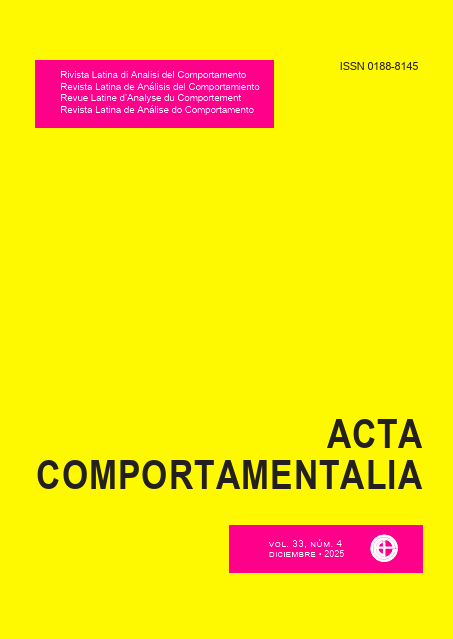
Multiple Exemplar Instruction With Echoic and Bidirectional/Incidental Naming in Autistic Children
DOI:
https://doi.org/10.32870/ac.v33i4.88759Keywords:
bidirectional naming, incidental bidirectional naming, echoic, multiple exemplar instruction, autistic childrenAbstract
In typically developing children, the integration of speaker and listener repertoires usually emerges between the ages of two and three years. According to the Naming Theory, this integration results from repeated and intertwined occurrences of listener responses, echoic behavior, and tacts during social interactions. This integration gives rise to Bidirectional Naming (BiN), where teaching speaker responses to objects/events results in the emergence of listener responses, and vice-versa. Furthermore, when this integration becomes a generalized behavioral relation, it leads to Incidental Bidirectional Naming (Inc-BiN), wherein speaker and listener responses to stimuli emerge following incidental exposure to their names. Inc- BiN is considered a pivotal repertoire for full language development. However, autistic individuals often present deficits in these repertoires, requiring specific interventions to promote their emergence. Multiple Exemplar Instruction (MEI) has been suggested as an effective procedure for inducing Inc-BiN, but questions remain regarding the variables that modulate its effectiveness, particularly the role of echoic responses. The present study evaluated the effect of a Multiple Exemplar Instruction (MEI) consisting of intraverbal tact and auditory-visual matching-to-sample (AVMTS) trials, with echoic requirement (MEIwec) and without echoic requirement (MEIwoec) in the AVMTS trials, on the induction of BiN and Inc-BiN in four autistic children. Participants underwent up to five experimental stages: BiN/Inc-BiN pre-tests, MEI exposure (wec and/or woec), BiN/Inc-BiN post-tests, and generalization and maintenance tests. The design allowed comparisons across different MEI sequences and included the evaluation of spontaneous echoic responses during sessions. Results indicated that two participants exposed to MEIwec and one participant exposed to MEIwoec demonstrated the emergence of BiN and Inc-BiN in post-tests. Conversely, one participant, initially exposed to MEIwoec and subsequently to MEIwec, did not present BiN or Inc-BiN. Generalization and maintenance outcomes varied among participants. Notably, spontaneous echoic behavior appeared associated with successful induction of BiN and Inc-BiN, suggesting that the reinforcing functions of social stimuli and observation responses may play a critical role in modulating MEI effects. The findings highlight the importance of considering the reinforcing properties of stimuli and observation responses in interventions aimed at inducing integrated speaker and listener repertoires in autistic children. They also underscore the need for further studies to clarify the specific contributions of echoic behavior and to explore the effects of MEI variations systematically. Future research should adopt robust pre- and post-test measures for BiN and Inc-BiN and examine the influence of social reinforcement and observational learning functions more closely.
Downloads
Downloads
Published
How to Cite
Issue
Section
License

<a rel="license" href="http://creativecommons.org/licenses/by-nc-sa/4.0/"><img alt="Licencia de Creative Commons" style="border-width:0" src="https://i.creativecommons.org/l/by-nc-sa/4.0/88x31.png" /></a><br />Este obra está bajo una <a rel="license" href="http://creativecommons.org/licenses/by-nc-sa/4.0/">licencia de Creative Commons Reconocimiento-NoComercial-CompartirIgual 4.0 Internacional</a>.